having children without "having" children
a bite-sized Q&A with childfull pastor Lisa Yebuah

“I don’t know that my life has ever been childless,” Pastor Lisa says when we sit down for lunch to catch-up. She has arrived to the food hall looking sharp as always in white jeans that make her mahogany skin nearly shine. While waiting for the restaurant pager to buzz between us, she elaborates, “I mean, definitely no kids have come through my underground railroad, but my life has always been filled with children, just not children that have lived under my roof.”
Yes, my pastor calls her nether regions her “underground railroad,” and yes, I’m fully aware how lucky I am. Lisa is known among our people as not just a local pastor but a life enthusiast who uses phrases like “I just peed glitter” as a sign of pastoral approval. I e-mailed her when I began writing Someone Other Than a Mother because I decided I was building my own squad of sorts. Or an anti-squad. An anti-squad of women who are fighting the falsehood that we don’t really matter until we’re somebody’s mother.
Lisa—single and forty-one years old when I first interviewed her—is quick to affirm that children are a central part of her vocation. She uses the example of infant baptism to illustrate. Along with asking parents to raise their child in the faith, there’s this part in the ritual where Lisa asks us in the pews to make a pledge, too: We will pray for them to walk in the way that leads to life. We will surround them with a community of love and forgiveness. With God’s help, we will proclaim the good news. And, she tells me, she repeats every “We will…” right along with us.
So, in this month’s Q&A from the book’s cutting room floor, you’ll hear more from Lisa on how to “have” children without “having” children, the moment she decided to chose margin over motherhood, and why she thinks your life—every life—is a template for the holy.
“Jesus reminds us that we are enough. If I never got married, I am enough. If I don’t give birth, I am enough.” We are nearing the end of lunch together but Lisa’s conviction is coming to a crescendo. “How beautiful are the feet of those who bring good news,” she declares, quoting scripture as pastors do. “Hard stop.”
Erin Lane: Ok. Let’s start with an easy, not-so-easy question. How do you feel about the word “childfree”? Or “bio-childfree”? I’m always trying to come up with these neologisms, with little success.
Rev. Lisa Yebuah: Yeah, I think I feel better saying “bio-childfree.” Because I actually need children around me. Sometimes, really, I’m like Jesus, these are the ones to whom the kingdom belongs? They stretch me theologically. And there are moments where they make Jesus’s words truer. As adults, we don’t know what we’re doing. Maybe we should hand everything over to them. They know how to handle power better than we ever could. So, childfull but biologically childfree, yes.
Erin: Kind of like God?
Lisa: Exactly.
Erin: Tell me about your upbringing.
Lisa: I grew up in Summerville, South Carolina where my mom was an educator for Head Start and my dad was a leader in the United Methodist Church. Back then, I probably would have subscribed to the idea that marriage plus procreation equals a woman’s highest purpose. But as I grew older, my perspective on purpose grew too. I went to graduate school, began working in local congregations, and eventually got ordained—a special word for those given special authority to act on the church’s behalf.
Erin: When did you realize you didn’t feel called to be a parent?
Lisa: There was a pastoral crisis I attended to when I was 33 or 34. It was pretty emotional and intense, like an episode straight out of Law & Order Special Victims Unit. I got home late that night and sat in the driveway trying to debrief and when I walked into the house, it was very quiet.
And I remember thinking, “What would I have done if I had had children?” And not, “Oh would I have been able to pick them up from school? Would I have been able to get them home to get them dinner? Would I have had a spouse that would have been able to tell them where their mom was?” That’s not what I was thinking. I got home and I was like, literally, if my child needed me, needed to curl up in my lap, needed me to offer up words of blessing over them today, needed to be physically close, I don’t know that I would have had the margin for it.
When I let the bishop laid hands on me and said that I’ve been called to “take thou the authority to serve and not to be served”— it just doesn’t leave enough by the time I get home to parent in the way I’d want to. Maybe I could eek something out, but I had to start getting honest with myself.
Erin: Well, you’re in good company. I think Jesus is a terrible role model for marriage, parenting, and settling down.
Lisa: I really hadn’t thought about that. Like, is Jesus who you would call to babysit your kids? From what I understand of Jesus’s life in scripture, it would be very hard for me to imagine Jesus being able to make space in a particular way to have children living under his roof.
Erin: Right. Because “foxes have holes” and “birds have nests” but the Son of Man didn’t even have a roof. I think that’s why I like the term childfree. It’s not principally about being free from children but free for flourishing in other ways.
Lisa: That’s right. Being childfree gives me the margin to be incredibly attentive to children whose families of origin or communities don’t have the resources in a particular space or place to love those children well. In the last two years, in particular, there have been times when I have realized, Lord, you have put me in this place so that I can help this child to know that they are seen. Because their mom, their dad, for whatever reason, isn’t there to tell them how loved they are. So, God has re-narrated what it means for me to take care of my children.
Erin: What do you want people to understand about your life? I should note that you describe yourself on Instagram as “confetti in human form.”
Lisa: Yes! I think what I want to say to people is please don’t feel bad for me. Oh, God. Lord have mercy. That look that people give me. Because I really, literally, do not feel bad for myself. I don’t feel like I’ve missed it, like my opportunities are gone. You know, I don’t go to the gynecologist weeping. It’s not sad. I’m really not sad. So if you’re gonna give me the look, give me the look because I can’t get my hair to grow past a certain length. That makes me sad. Feel sad about that. But please just don’t be sad that my life doesn’t look like your life because it’s going to be wasted pity. There’s still fullness of life thereof.
Erin: I’ve heard you say your life is a template for God’s glory. What do you mean by that?
Lisa: I really believe that when you give me access to your life, I get to see how God chooses to work in you. Likewise, I can show other childless people who think they’re not enough that it’s okay if you never go to Pea’s in a Pod or whatever the thing is. It’s okay. I’m giving people a template for how God is going to show up in a glorious and wonderful way. I’m in a love affair with my life. I really do love my life.
Over the years, I had to learn to trust the voice of God. That God’s not punking me. That God’s not inviting me into some level of sacrifice. There’s this self-martyrdom that we love. If God is calling me not to have children, it must be that I have to suffer from it verses that my life’s just as full. And it can be a beautiful thing. You know it didn’t feel ominous when I discerned I didn’t want kids. It didn’t feel like I was about to lose something. It was just like, no, Lisa, recognize that in the same way that some people feel a thing, you don’t feel a thing. That’s you owning your truth. That’s them owning their truth.
And I can still show up for other people, and, you know, try to figure out what candy bar’s in a diaper at a baby shower with the same level of enthusiasm—I know a Twix from a Snickers, buddy—and that doesn’t mean a deficit. We’re just living very different experiences that will be a template for God’s glory.
P.S. Want to celebrate Lisa for doing her own work and sharing her own story? If so, you might consider joining her in supporting the Southeast Raleigh YMCA.
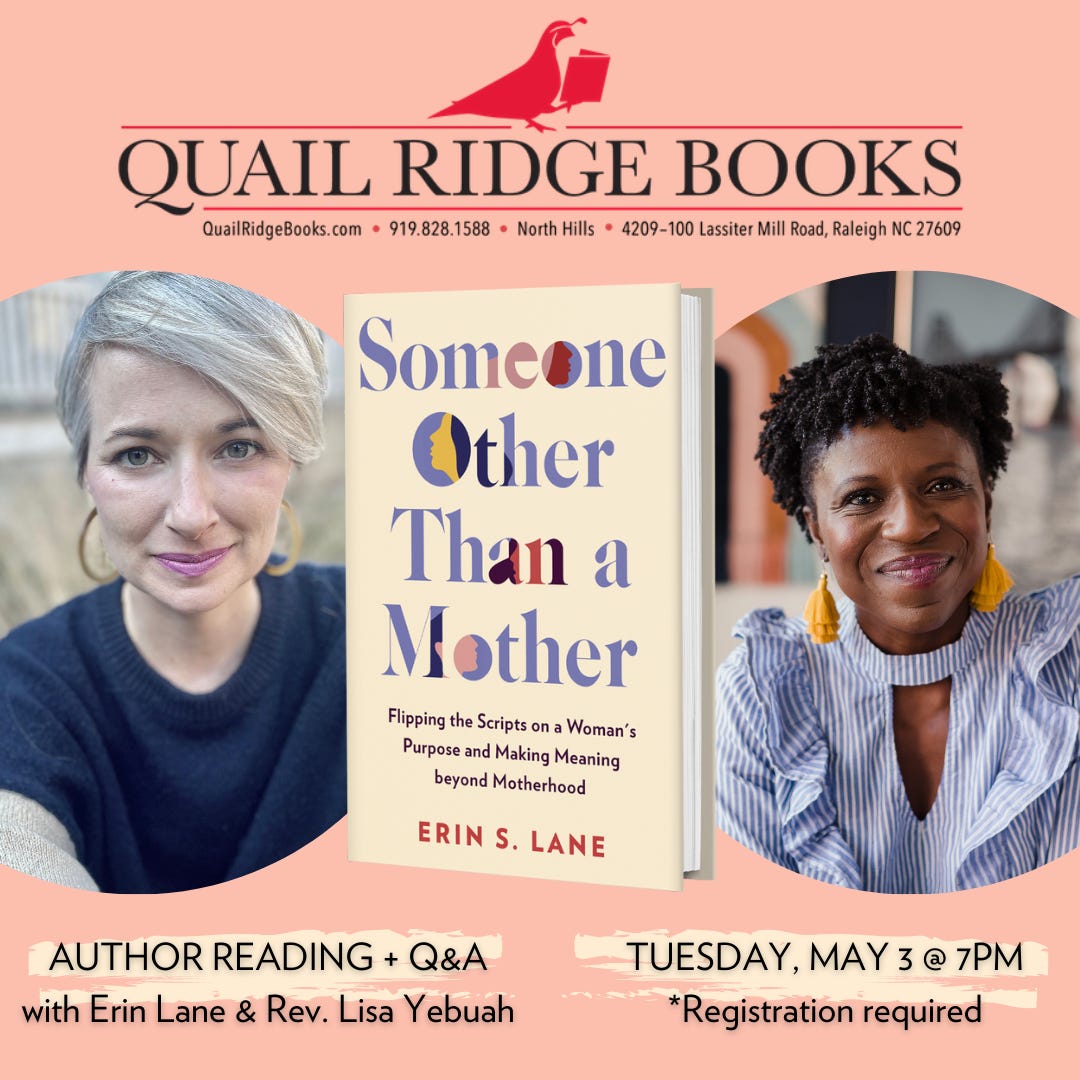
P.P.S. And! If you’re local, you might also consider joining the two of us for a reading and discussion of Someone Other Than a Mother at Quail Ridge Books on Tuesday, May 3rd @ 7pm. The event is free but registration is required.